Working Papers

Each paper publishes its parameters, sources, and calculations with it. All are working papers under CC BY 4.0, and the code and data are in the public repository.
The Continuous Evidence Generation Protocol: Two-Stage Validation (RWE → Pragmatic Trials)
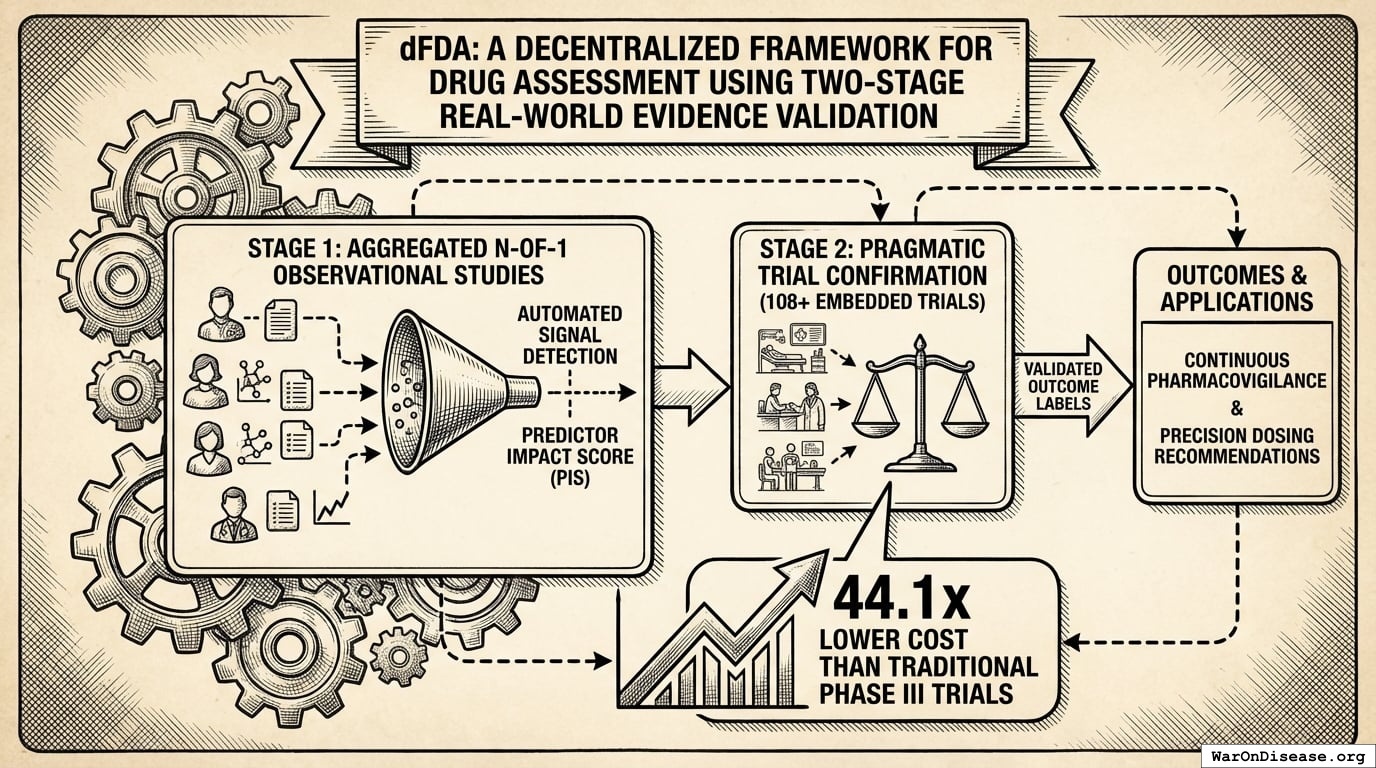
We present the Predictor Impact Score (PIS), a novel composite metric operationalizing Bradford Hill causality criteria for automated signal detection from aggregated N-of-1 observational studies. Combined with pragmatic trial confirmation (based on evidence from 108+ embedded trials), this two-stage framework would generate validated outcome labels at 44.1x (90% CI: 12.8x-210x) lower cost than traditional Phase III trials. This enables continuous, population-scale pharmacovigilance and precision dosing recommendations.
Ubiquitous Pragmatic Trial Impact Analysis
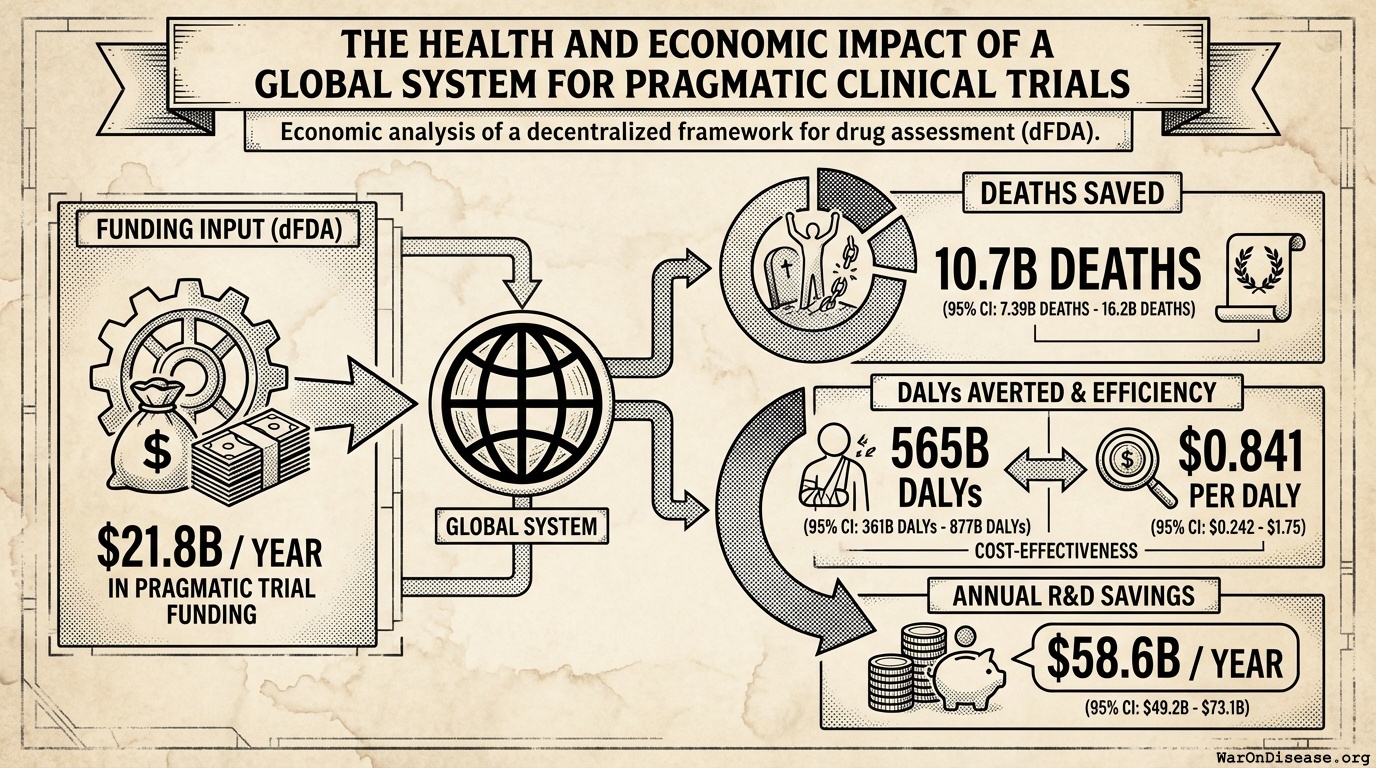
Only 15 diseases/year (95% CI: 8 diseases/year-30 diseases/year) get their first treatment each year. With 6,650 diseases (90% CI: 5,700 diseases-8,232 diseases) lacking effective treatments, the backlog would take 443 years (90% CI: 255 years-841 years) to clear. Integrating pragmatic trials into standard healthcare increases trial capacity 12.3x (90% CI: 4.92x-50.8x), cutting that timeline from 443 years (90% CI: 255 years-841 years) to 36 years (90% CI: 8.15 years-106 years). The average untreated disease gets a treatment 212 years (90% CI: 124 years-398 years) earlier, saving 10.7 billion deaths (90% CI: 6.24 billion deaths-20.3 billion deaths) at $9.62 (90% CI: $2.15-$32) per year of healthy life saved.
The Invisible Graveyard: Quantifying the Mortality Cost of FDA Efficacy Lag
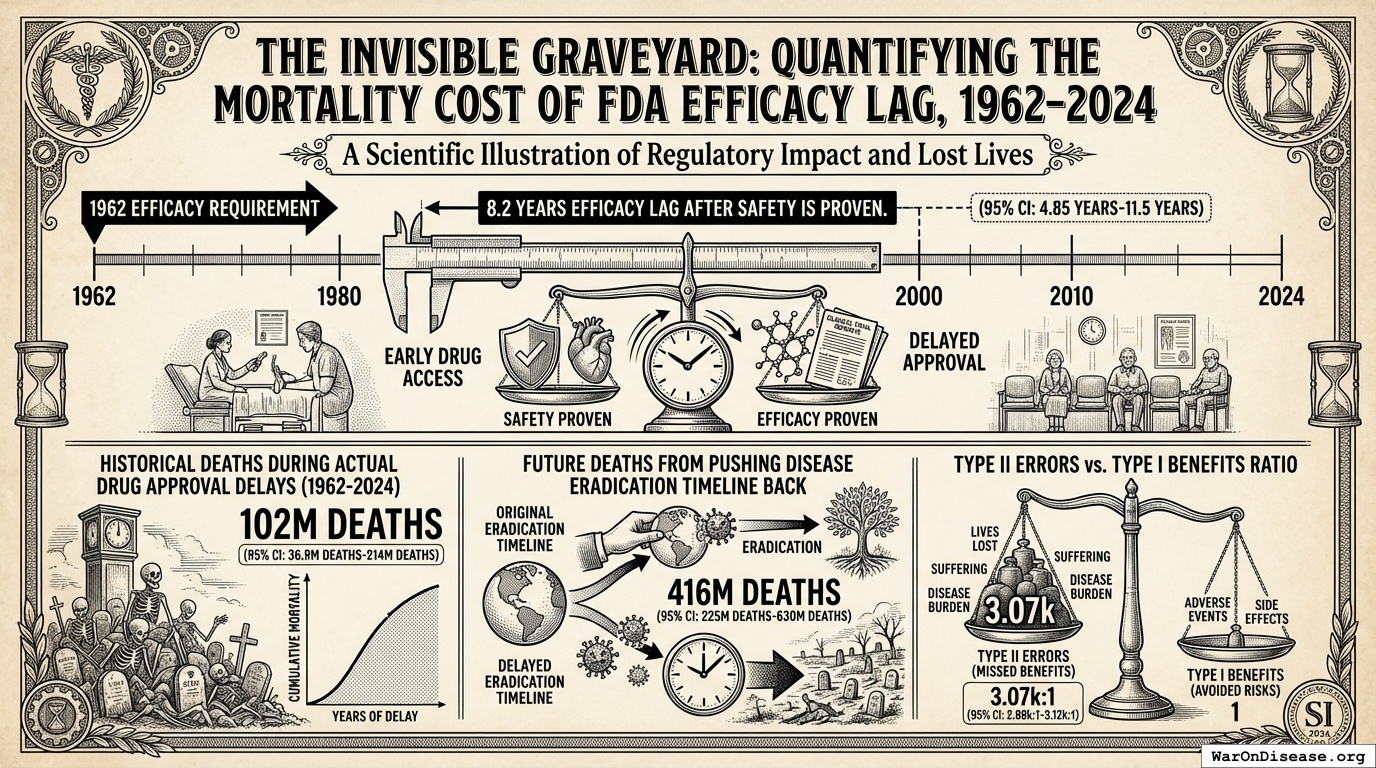
After proving a drug is safe, the FDA requires 8.2 years (90% CI: 4.84 years-11.5 years) to prove it works before patients can access it. We estimate this delay cost 102 million deaths (90% CI: 50.8 million deaths-169 million deaths) among people waiting for approved drugs (1962-2024). The human cost in death and disability of blocking good drugs is 3,389 (90% CI: 1,811-5,734) higher than the cost of approving bad ones.
Drug Development Cost Increase Analysis
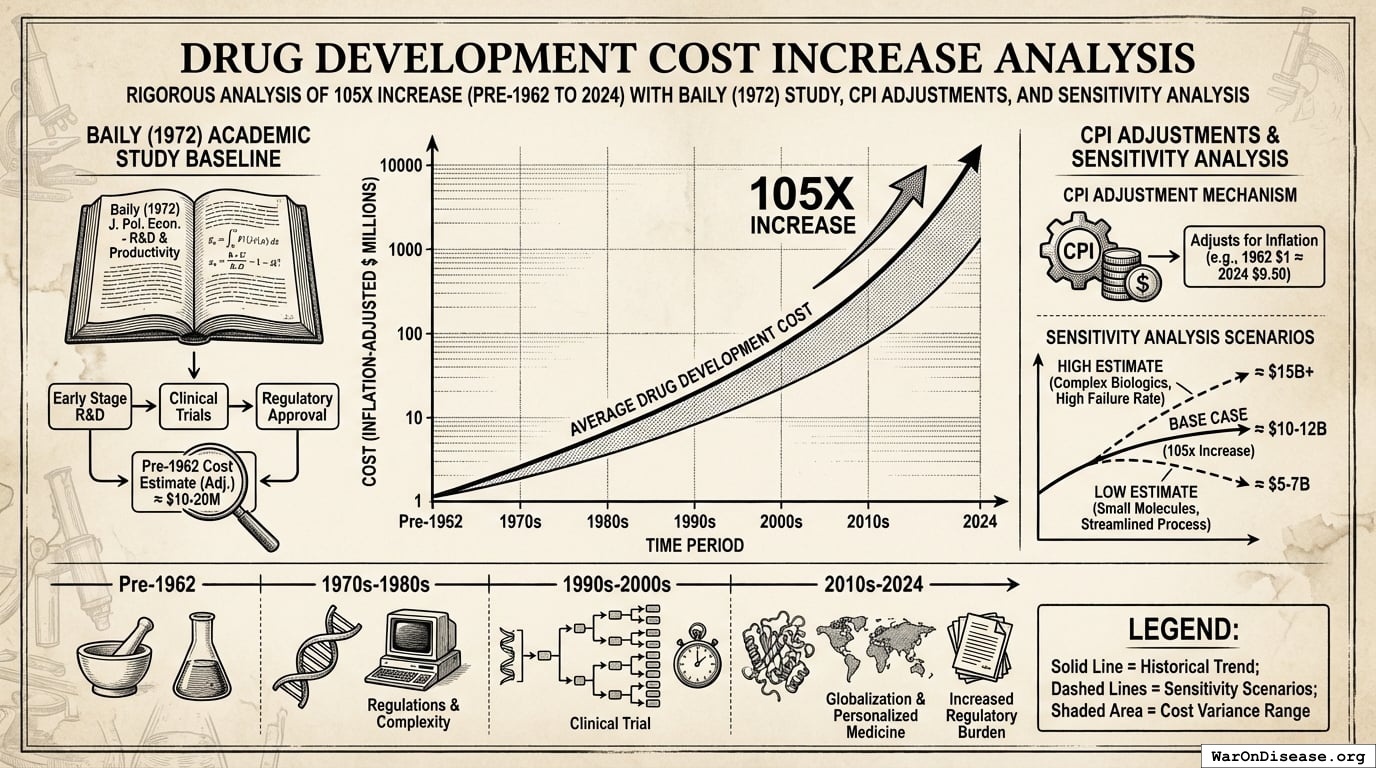
Rigorous analysis of the 105x (90% CI: 72.8x-149x) increase in drug development costs from pre-1962 to 2024, using Baily (1972) academic study with CPI adjustments and sensitivity analysis
Right to Trial & FDA Upgrade Act
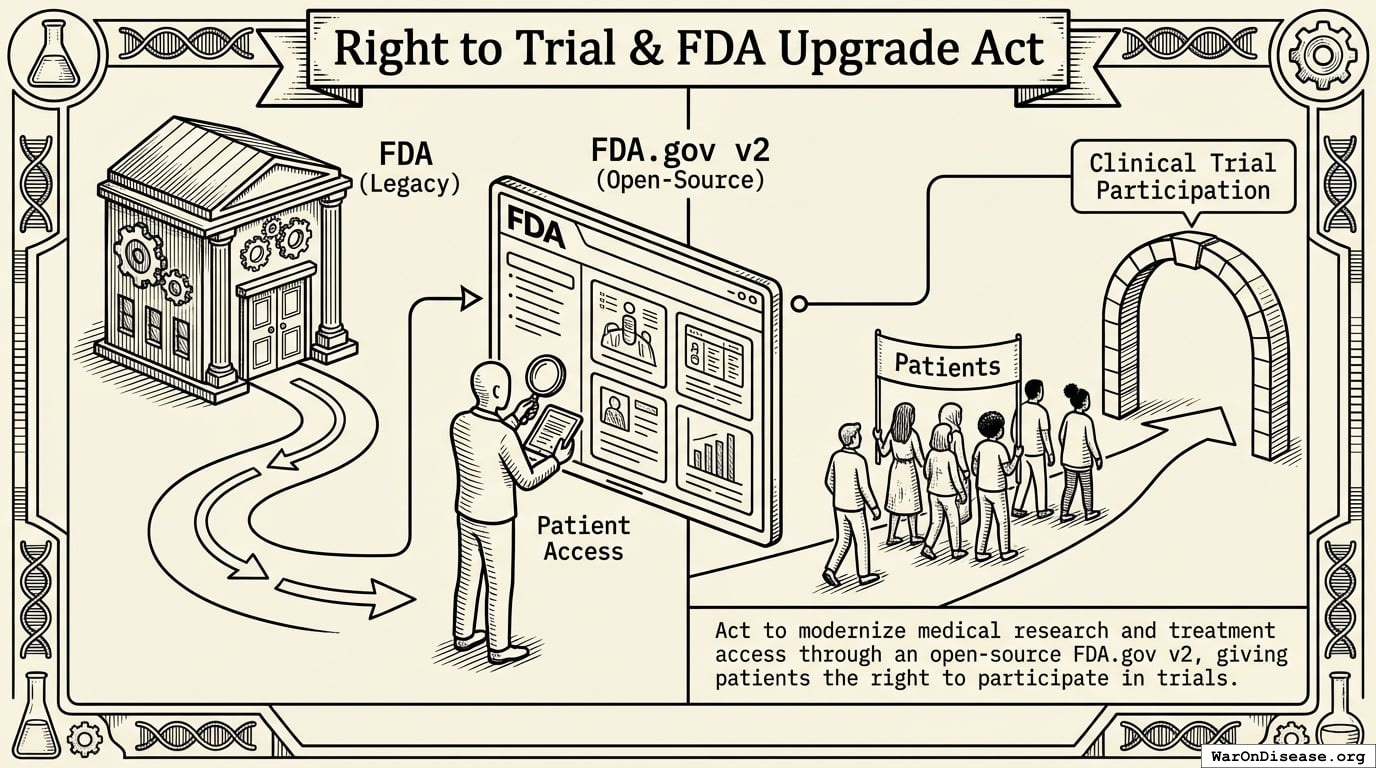
A universal right to try, with evidence. The Act authorizes commercial access after initial human safety testing and makes every covered treatment use teach us something.
Patient's Right to Trial Act: Potential Impact of Adoption in All 50 States
A conditional schedule-shift model of state legislation that lets post-Phase-1 treatments finance their own evidence generation and accelerates treatments for global diseases and aging.